An open exploration of global connectivity
Connecting the world.
Exploring what comes next.
Beneath the oceans lies the infrastructure connecting our digital world.
As the world's need to exchange information grows, how will these networks evolve—and what new possibilities could they unlock?
Illustrative connections · not actual cable routes · drag to rotate
01 / The invisible infrastructure
Our connected world has a physical foundation.
Every day, information moves between continents.
Scientific discoveries are shared across borders. Computing resources serve people thousands of kilometres away. Businesses, researchers, and communities depend on networks that connect the world.
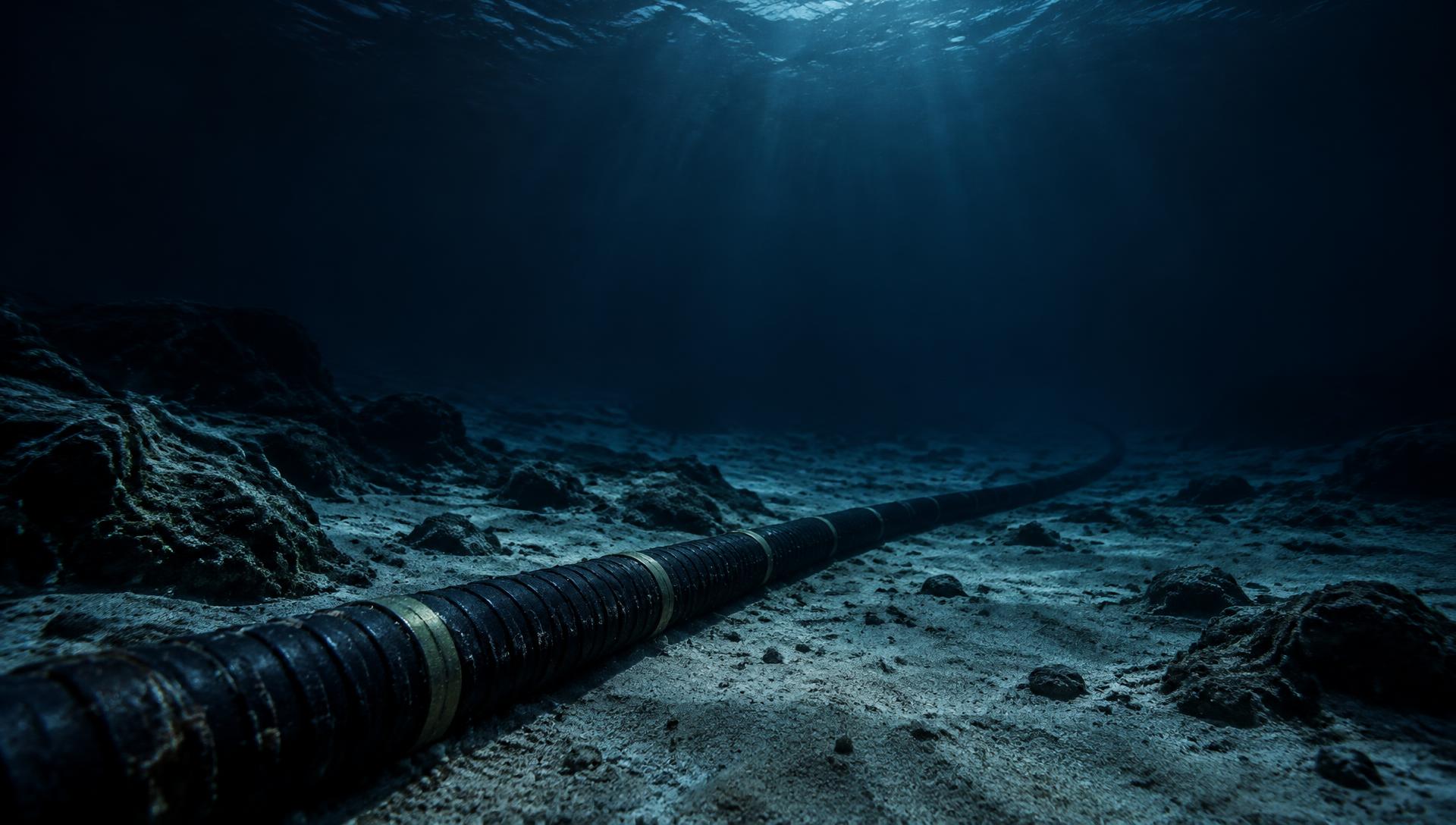
Much of this connectivity relies on an extraordinary infrastructure hidden beneath the oceans.
Image: conceptual illustration, not documentation of a specific system.
02 / Why connectivity matters
What becomes possible when the world is better connected?
More capable networks can help researchers collaborate, computing resources serve distant users, digital businesses reach new markets, and international services remain resilient.
But the true value of connectivity depends on more than capacity. Reliability, affordability, access, and the needs of the people using these networks matter too.
Science without the same geographical constraints
Researchers can access large scientific datasets and remote computing resources without having to own every major facility themselves.
Better international connectivity can support collaboration in astronomy, climate science, physics and medical research.
Connectivity enables data exchange. It does not automatically guarantee access to research resources, funding, or scientific participation.
03 / The multipetabit frontier
The next frontier of global connectivity.
As more information moves between continents, submarine networks must continue to evolve.
Increasing their capacity requires progress across interconnected disciplines—from optical transmission and amplification to electrical power, manufacturing, marine engineering, and systems integration.
Logarithmic scale · each gridline is 10×
At 1 Pb/s, per second, an ideal link moves
125 TB
Ideal theoretical throughput: bits = rate × time, ÷ 8 bits per byte, decimal units. Excludes protocol overhead, utilisation and practical constraints. Aggregate cable capacity is shared — no single user receives it.
1 Pb/s = 1,000 Tb/s
How do we build networks capable of carrying this much information across an ocean?
04 / Interactive cable system
The next frontier is a systems challenge.
Carrying more information across an ocean is not simply a matter of adding more fibres.
Optical transmission, signal amplification, electrical power, mechanical design, manufacturing, marine operations, and economics must work together. Select a component to explore it.
Purpose
Restore optical power at intervals along the route, typically every several tens of kilometres.
Principle
Optical amplifiers (commonly erbium-doped fibre amplifiers) boost all wavelengths at once without converting to electrical signals.
Limitations
Every amplifier adds noise; amplified noise accumulates over thousands of kilometres. Repeaters do not remove degradation.
Connects to
Each pump laser draws electrical power fed from shore.
Conceptual, not to scale. Repeater spacing and the power curve are illustrative. Read the technology overview →
05 / Open challenges
What still stands in the way?
Every advance creates new possibilities—and new questions. These are some of the unresolved problems on the path toward multipetabit systems.
Optical
Expanding usable optical spectrum
Wider bandwidth per fibre raises capacity without adding fibres.
Constraint: Amplifier bandwidth, efficiency and noise performance beyond the C-band.
Optical
Scaling spatial channels
More parallel paths is the most direct route to higher aggregate capacity.
Constraint: Each path needs amplification, space in repeaters, and electrical power.
Optical
Multicore fibre integration
Multiple cores per fibre could multiply paths within existing cable dimensions.
Constraint: Crosstalk, splicing, fan-in/fan-out, amplification and long-term qualification.
Power
Electrical power constraints
Subsea amplifiers need power delivered over thousands of kilometres.
Constraint: Feed voltage, conductor resistance and route length cap available power.
Power
Optical amplifier efficiency
More capacity per watt eases the power budget.
Constraint: Pump efficiency, thermal management and reliability over decades.
Mechanical
Cable manufacturability
Higher fibre counts change cable design and production.
Constraint: Dimensions, handling, production capacity and testing.
06 / Explore the platform
Welcome to MultiPetabit.
An independent, open research initiative exploring the technologies, infrastructure, and people shaping the next generation of global communications.
Discover how submarine networks work, explore their limits, compare emerging approaches, and investigate the path toward multipetabit connectivity.
Because the future of connectivity is not only about how much information we can move.
It is about what the world can do with it.
Explore MultiPetabit